

How to Properly Test Drive a Second Hand Car: A Darwin Dealer’s Checklist
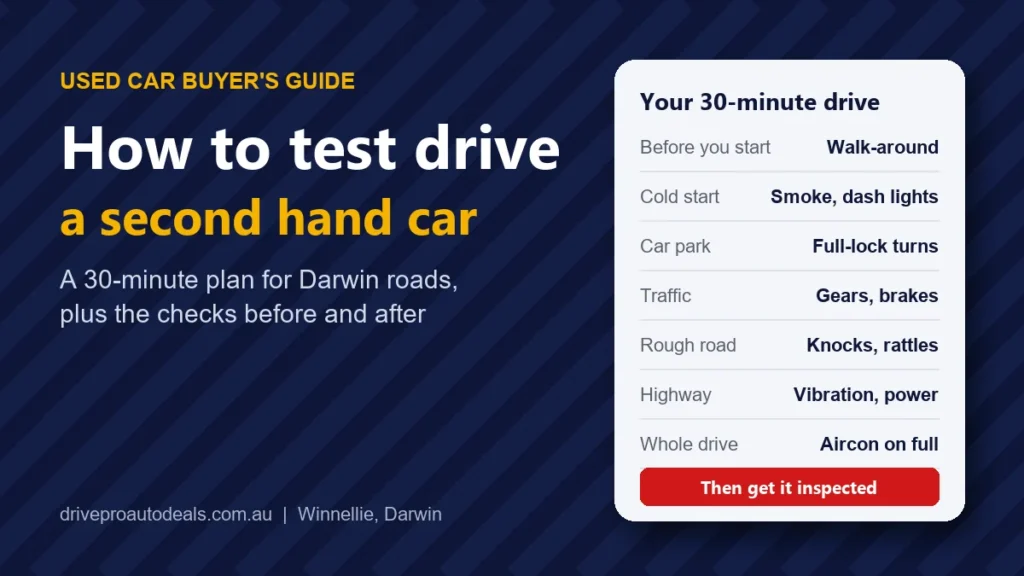
In brief: give yourself at least 30 minutes. Check the car over before the engine runs, ask for a cold start, then drive it slowly, in traffic, over a rough road and at highway speed with the radio off. Run the aircon on full the whole time. Afterwards, look underneath for fresh leaks and check for warning lights. If you like the car, get it inspected before you pay.
Most people decide whether they like a car in the first five minutes of driving it. That’s fine for comfort and feel, but it’s not long enough for faults to show up. A gearbox that slips when it’s hot or aircon that gives up after ten minutes won’t show up on a lap around the block.
We hand over keys for test drives every week at our Winnellie yard. This guide covers what to check, in the order you’d check it.
Before you go: book it properly
Call ahead and book a time rather than turning up. It gives you two things. You can ask the seller not to start the car before you get there, and you can plan to see it in daylight, when paint damage and leaks are much easier to spot.
Bring your driver licence, a friend if you can (one of you drives, the other listens and watches), your phone for photos, a small torch and a few paper towels for checking fluids.
It also pays to run the paperwork checks before you drive anywhere. A search on the official PPSR site costs $2 and tells you whether there’s money owing on the car or whether it’s been written off or reported stolen. Our guide on how to check if a car has money owing shows you how. There’s no point falling for a car you can’t legally buy.
What to check before you start the engine
Walk around the car first. Look along each side for ripples in the panels, paint that doesn’t quite match, and gaps between panels that are wider on one side than the other. Those are the usual signs of accident repairs.
Then check the tyres. All four should be a similar brand and wear evenly. Wear on just the inside or outside edge usually means the wheel alignment is out, and sometimes that the suspension has taken a hit.
Look under the car with your torch for fresh drips. A few old marks on an older car are normal. Wet oil, green or pink coolant, or red transmission fluid is worth asking about.
The 5 F’s
Before driving any car, a quick way to remember the under-bonnet checks is the 5 F’s:
- Fuel: is there enough for a proper drive?
- Fluids: engine oil, coolant and brake fluid levels (only check coolant with the engine cold)
- Fan belt: no cracks or squealing
- Faults: any warning lights that stay on after the engine starts
- Feel: seat, mirrors and steering wheel set up so you can see and drive safely
On the oil dipstick, the level should sit between the two marks. Oil that looks milky or like a chocolate milkshake can point to a head gasket problem.
Ask for a cold start
A cold engine tells you more than a warm one. Some engines rattle for a few seconds on a cold start, some smoke, and some idle roughly until they warm up. A seller who has had the car running before you arrive may be hiding one of those. Touch the bonnet when you get there. If it’s warm and nobody mentioned it, ask why.
When you turn the key, every warning light on the dash should come on for a moment and then go out. A light that never comes on at all can mean a bulb has been removed to hide a fault.
Watch the exhaust as it starts. A little white vapour on a cool morning is normal. Blue smoke means the engine is burning oil. Thick white smoke that keeps coming once it’s warm can mean coolant is getting into the engine.
A 30-minute test drive route
Plan a route with a bit of everything. Each stretch shows you something different.
| Part of the drive | Time | What it tells you |
|---|---|---|
| Car park, slow turns | 3 to 5 min | Steering noise, clicking CV joints on full lock, reverse camera and sensors |
| Suburban streets and traffic | 10 min | Gear changes, brakes in stop-start traffic, how it idles at lights |
| A rough or patched road | 5 min | Suspension knocks, rattles and loose trim |
| Highway at 80 to 100 km/h | 10 min | Power, vibration through the wheel, wind noise, cruise control |
Keep the radio off the whole time. From our yard, Bombing Road, the Stuart Highway and Tiger Brennan Drive give you all four in half an hour.
On a quiet, straight stretch:
- Brake firmly from about 60 km/h. The car should pull up straight, with no shudder through the pedal or wheel.
- Relax your grip on the wheel for a second. The car shouldn’t drift hard to one side.
- Accelerate firmly up to speed. An automatic should change smoothly, without the revs flaring between gears. A manual’s clutch shouldn’t slip.
- Let it coast. Nothing should drag, grind or whine.
On a manual, notice where the clutch bites. If it only grabs right at the top of the pedal travel, it’s probably getting worn. On a 4WD, engage four-wheel drive on a gravel patch and listen for clunks.
How to test the air conditioning in Darwin heat
Up here the aircon is a deal-breaker, so give it a proper test. Set it to the coldest setting and full fan from the moment you start the car. It should blow cold within a minute or two and stay cold for the whole drive, including when you’re stopped at lights.
Try every fan speed and every vent, including the rear vents if the car has them. Listen for a loud click or grind when the compressor kicks in, and notice any musty smell.
If it starts cold and gets warmer as you drive, it could be a simple regas or something more expensive like a leak or a failing compressor. Either way, it’s something to raise when you talk price. Switch to heat for a moment too, so you know the temperature controls work.
What to check after the test drive
Park on a clean patch of ground and leave the engine idling for a minute. Then:
- Look under the car again for anything that wasn’t dripping before.
- Check the temperature gauge sat in the normal range the whole time.
- Turn the car off and restart it. It should start easily when hot.
- Check the dash for any new warning lights.
- Open the bonnet and listen for ticking, hissing or a strong burning smell.
Write down anything you noticed while it’s fresh, then ask the seller about each one, and pay attention to how straight the answers are.
If you’re still keen, get the car checked by a mechanic before you hand over money. Our Winnellie workshop does car inspections on cars we sell and cars we don’t, and any good local mechanic can do the same. A short drive can’t show you everything a mechanic sees on a hoist.
Red flags on a test drive
Walk away, or at least slow down, if you see any of these:
- The engine is already warm and nobody told you why
- The seller wants you to drive a short loop or a set route
- A warning light stays on, or one never lights up at start
- The car pulls to one side, shakes under braking or slips between gears
- The aircon can’t stay cold
- Smoke from the exhaust once the engine is warm
- The service history doesn’t match the kilometres, or there isn’t one
- Pressure to pay a deposit before you’ve finished checking the car
That last one applies at dealerships too. A good dealer is happy for you to take your time. If you’re not sure what to ask when something feels off, our list of questions to ask a private car seller works just as well at a yard.
Test driving with a dealer or a private seller
At a licensed dealer, the car is registered, and dealers normally insure their stock for test drives. Ask anyway, and ask what the excess is if something goes wrong.
With a private seller, ask before you drive whether their insurance covers another driver. In the NT, registration includes no-fault injury cover through the Motor Accidents Compensation Scheme, but that doesn’t pay for damage to the car or anyone else’s property. Meet somewhere safe and public, take a friend, and run the NT rego check first so you know the rego is current.
The other difference is what happens after the sale. When you buy from a dealer, the consumer guarantees under the Australian Consumer Law apply. As the ACCC explains, most of them don’t apply to a private sale, so a proper test drive and an inspection matter even more when you’re buying privately.
Cars you can test drive this week
Ready to put this checklist to work? Here are some of the cars on our yard right now. Pick one, call 0411 634 174 or 0450 489 453, and we’ll have it cold and ready when you arrive.
 2018 Honda Jazz MY192018175,400 kmPetrolAutomatic$13,800View car →
 2017 Toyota RAV4 GX MY182017158,000 kmPetrolAutomatic$19,299View car →
 2017 Subaru Impreza AWD2017110,000 kmPetrolAutomatic$16,500View car →
Want to see everything? Browse all our used cars for sale in Darwin. We’re at 30 Bombing Road, Winnellie, open Monday to Saturday 9am to 6pm and Sunday 11am to 4pm.
Frequently asked questions
How long should a used car test drive be?
At least 20 to 30 minutes. That’s long enough for the engine and gearbox to reach full temperature, which is when a lot of faults show up, and long enough to cover slow streets, traffic, a rough road and highway speed.
What is the best way to test drive a used car?
Check the car over before starting it, ask for a cold start, drive a mixed route with the radio off, run the aircon on full the whole time, then recheck for leaks and warning lights afterwards. Get a mechanic’s inspection if you’re serious about buying.
What are the 5 F’s to check before you drive?
Fuel, fluids, fan belt, faults (warning lights) and feel (seat, mirrors and steering set up properly). It’s a quick memory aid for the basic checks before any drive.
Am I insured when I test drive a used car?
Dealers normally insure their stock for test drives, but ask about the excess. With a private seller, check their policy covers you first. NT rego covers injuries through the MAC scheme, not damage to cars or property.
Can I take a used car to my own mechanic?
You should be able to. Any seller with nothing to hide will agree to an inspection by a mechanic you choose. If they refuse, treat it as a red flag.
Should I test drive more than one car?
Yes, if you can. Driving two or three similar cars back to back makes it much easier to notice a gearbox that feels slow or a suspension that’s tired.
About the author
Sandesh Budhani is a partner in DrivePro Auto Deals, a licensed motor vehicle dealer (LMVD1100) at 30 Bombing Road, Winnellie NT 0820. The team buys, sells, trades in, rents and services cars for Darwin drivers every day, so the advice here comes from the dealer’s side of the desk. Questions about a car you’re looking at? Call the yard on 0411 634 174 or 0450 489 453.
Looking for a used car in Darwin?
DrivePro Auto Deals is a licensed dealer (LMVD1100) at 30 Bombing Road, Winnellie. Browse our stock, get a trade-in value or call us on 0411 634 174.
Browse used carsGet a trade-in value