

Toyota Hilux Common Problems by Year and Engine: A Used Buyer’s Guide
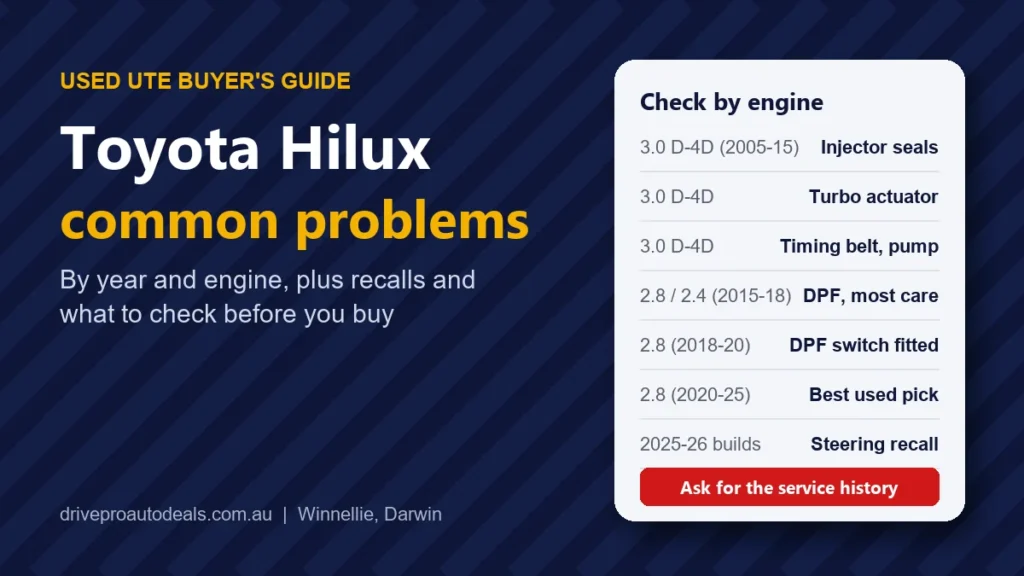
In brief: the most common Toyota Hilux problems depend on the engine. On the older 3.0 litre D-4D diesel (2005 to 2015), watch for leaking injector seals, which can fill the oil with carbon, plus turbo actuator faults and water pump leaks. On the 2.8 and 2.4 litre diesels (from late 2015), the big one is the diesel particulate filter (DPF), which was the subject of a class action that Toyota agreed to settle for $750 million in October 2026. Be most careful with diesels built from late 2015 to mid-2018. On any used Hilux, check the clutch, springs, chassis and recall history before you pay.
You’ll find Hiluxes on stations, building sites and boat ramps all over the Territory. That helps when you’re buying, because parts are easy to find and every mechanic knows them. It also means plenty of used ones have worked hard, and each generation has its own weak spots.
This guide sorts Toyota Hilux common problems by year and engine, so you know which ones apply to the ute in front of you and what to check before you buy.
Which Hilux are you looking at?
Start by working out the generation and engine. The build date is on the compliance plate, and the engine code is on the rego papers or in the service book.
| Generation | Years (approx.) | Main diesel engines | Problems to focus on |
|---|---|---|---|
| 7th gen (N70) | 2005 to 2015 | 3.0 litre 1KD-FTV D-4D, 2.5 litre 2KD-FTV in some 2WD models | Injector seals, oil sludge, turbo actuator, water pump, timing belt |
| 8th gen (N80), early | Late 2015 to mid-2018 | 2.8 litre 1GD-FTV, 2.4 litre 2GD-FTV | DPF blockages, dusting, early auto and ride complaints |
| 8th gen (N80), updated | Mid-2018 to 2020 | Same engines, manual DPF switch added | DPF, but with a manual regeneration button |
| 8th gen (N80), facelift | Late 2020 to 2025 | 2.8 litre lifted to 150 kW, redesigned DPF, 48V on some 2024 grades | Fewer DPF problems, normal wear |
| 9th gen | Late 2025 on | 2.8 litre only, 48V on many auto grades | Too new to judge, check recalls |
Petrol Hilux models (2.7 litre four and 4.0 litre V6) don’t have the diesel injector or DPF problems, but they use more fuel.
Toyota Hilux years to avoid (and the best years to buy)
Some Hilux years need more care than others, mostly because of the DPF.
| Years | Verdict | Why |
|---|---|---|
| 2005 to 2015 (3.0 diesel) | Buy on history | Good engine if the injector seals and oil have been looked after. Avoid ones with no service records. |
| Late 2015 to mid-2018 (2.8 and 2.4 diesel) | Most care needed | The worst years for DPF problems, built before the manual DPF switch. Ask for proof of the DPF fix. |
| Mid-2018 to 2020 | Good with checks | Manual DPF switch fitted. Still inside the class action period, so check the DPF history. |
| Late 2020 to 2025 | Best used buy | Redesigned DPF and more power. The pick if your budget stretches. |
| 2025 on | Check recalls | New and still under warranty, but look up any recall work first. |
If your budget sits lower, a late 3.0 litre Hilux (2011 to 2015) with receipts for injector seal work is often a safer buy than an early 2.8 with an unknown DPF history.
3.0 litre D-4D Hilux problems (N70, 2005 to 2015)
The 3.0 litre 1KD-FTV is tough and simple to work on, but it has a few well-known faults. Most come down to how it was serviced.
Leaking injector seals and oil sludge
The copper seals under the injectors can leak. Hot combustion gas then gets into the top of the engine and mixes with the oil, which turns into thick carbon sludge. Over time that sludge can block the oil pickup in the sump and starve the engine of oil, which can wreck it.
What to look for: a “chuffing” sound from the top of the engine, black gunk around the injectors, or oil that turns very black soon after a change. Ask whether the injector seals have been replaced and whether anyone has checked the oil pickup.
Cold-start rattle
A rattle or knock for the first few seconds from cold is common on this engine. It’s often linked to injector wear.
What to look for: ask the seller not to start the ute before you arrive, then start it yourself from cold and listen.
Turbo actuator and limp mode
The variable-vane turbo is controlled by an electronic actuator. When it fails, the engine drops into limp mode with very little power, often with fault code P1251 stored.
What to look for: a lack of power, the engine light on, or a seller who mentions “limp mode”. The actuator can usually be replaced without buying a whole turbo.
Water pump and timing belt
The 1KD uses a timing belt, and the water pump can weep coolant as it ages. Most owners replace both at the same time.
What to look for: pink or crusty coolant marks at the front of the engine, a coolant level that keeps dropping, and a receipt for the last timing belt change.
EGR and intake carbon
Carbon builds up in the EGR valve and intake over time, especially on utes that mostly do short trips. It robs power and can make the engine run rough.
What to look for: black smoke, rough running or flat performance. A catch can fitted by a known workshop is a good sign the owner cared.
Clutch slip
Manual Hilux clutches wear faster on utes that tow, carry heavy loads or spend time in sand.
What to look for: a clutch that bites very high, slips when you accelerate hard in a high gear, or judders when you take off.
Our used car buying checklist covers the rest of the engine bay and paperwork checks.
2.8 and 2.4 litre Hilux problems (N80, 2015 to 2025)
The 1GD-FTV 2.8 and 2GD-FTV 2.4 use a timing chain rather than a belt, and they’re strong engines. Their main weakness sits in the exhaust.
DPF blockages and the class action
The DPF traps soot and is meant to burn it off (“regenerate”) while you drive. On many Hilux, Prado and Fortuner diesels sold from October 2015 to April 2020, it didn’t burn off properly in normal driving. Owners reported warning lights, white smoke, a strong exhaust smell, high fuel use and limp mode.
Toyota added a manual DPF regeneration switch from mid-2018 and fitted a redesigned DPF with the 2020 facelift. Owners also took Toyota to court. In October 2026, Toyota agreed to a $750 million settlement covering about 264,000 vehicles bought between 1 October 2015 and 23 April 2020, subject to Federal Court approval. If you own or are buying one from that period, the class action website explains who can claim.
What to look for: a DPF warning light, white smoke, frequent “regeneration in progress” messages, or dealer records showing DPF updates or replacement. Ask for the service history in writing.
Is a DPF delete legal?
No. Removing or disabling the DPF on a road vehicle is illegal, can void your insurance and can stop the ute passing an inspection. Walk away from a Hilux with a “DPF delete” kit or tune unless the original system has been put back properly, because an owner who cut that corner may have cut others.
Dusting
Some early N80 owners reported fine dust getting past the air filter into the engine, which is known as “dusting”. It’s a real worry on Top End dirt roads.
What to look for: dust on the clean side of the air box or in the intake pipe after the filter. Ask when the air filter was last changed.
Automatic gearbox
The six-speed automatic is generally strong. Some owners of earlier N80 models reported hesitant or harsh shifts.
What to look for: slow or harsh changes, flaring revs between gears, or hesitation when you take off.
4WD actuator
Utes that rarely leave the bitumen can end up with a sticky 4WD actuator.
What to look for: shift from 2H to 4H at low speed on the test drive. The 4WD light should go solid. If it keeps flashing, the actuator may be stuck.
Recalls to check on a Toyota Hilux
Recalls are free to fix, but only if someone has had the work done. Ask the seller, then check the VIN yourself.
- Power steering recall (2025 to 2026): 13,390 Hilux utes built between August 2025 and February 2026 with a Toyota Genuine bull bar or nudge bar with a light were recalled. The power steering earth connection may be wrong, and steering assistance can drop out without warning. See recall REC-006578 for details.
- DPF updates: earlier N80 diesels may have had DPF software or hardware updates under service campaigns. Ask for dealer records.
- Other recalls: search the VIN on the Australian Government’s vehicle recalls site or ask any Toyota dealer to check it.
While you have the VIN, run a $2 PPSR search too. Our guide on how to check if a car has money owing walks you through it.
Problems on any used Hilux (work ute wear)
Whatever the engine, a used Hilux has usually worked for a living. These are the checks that apply to every generation.
- Leaf springs: sagging rear springs on utes that have carried a heavy tray, canopy or water tank.
- Chassis: rust or cracks along the rails, especially behind the cab on dual cabs with heavy trays.
- Rust underneath: check the chassis, brake lines and tray mounts on utes used near the coast or at boat ramps.
- Towing wear: a worn tow ball, a scraped rear bar and a tired clutch point to heavy towing.
- Front end: worn ball joints, tie rod ends and split CV boots on high-kilometre 4x4s.
- Modifications: big lifts, large tyres and heavy bars may need engineering approval and add weight.
Why Top End driving matters for a Hilux
Darwin conditions make some of these problems more likely, so ask where the ute has lived and how it was driven.
- Short trips around Darwin, Palmerston and Casuarina don’t give a 2.8 diesel’s DPF time to regenerate. A ute that’s only done school runs and stop-start traffic is more likely to have DPF trouble than one that’s done highway kilometres.
- Bulldust and dirt roads test the air filter seals, so dusting is a bigger risk on station and bush utes.
- Heat is hard on the cooling system and the air conditioning. Run the aircon on full for the whole test drive.
- Wet season water crossings and boat ramps bring rust and silt. Check under the carpets and around the diffs.
What to check on a used Hilux test drive
- Start it from cold and listen for a rattle or knock.
- Watch the dash for engine, DPF, 4WD and airbag warning lights.
- Drive it until it’s fully warm, including some time at 100 km/h.
- Look for white, blue or black smoke when you accelerate hard.
- Feel how the clutch or automatic changes gear, especially when taking off.
- Engage 4WD high, and low if you can, on a gravel surface.
- Check the aircon blows cold the whole time.
- Look underneath for oil and coolant leaks, chassis damage and sagging springs.
- Ask for the service history and receipts for injector, turbo, timing belt or DPF work.
If you don’t have a mechanic, our workshop can do a pre-purchase inspection in Darwin. On a diesel ute, it can pick up injector, turbo and DPF problems a test drive won’t show.
Is a used Toyota Hilux still a good buy?
Yes, for most buyers. The Hilux is easy to get parts for anywhere in the NT, it holds its value and most mechanics know it well. The common problems with the Toyota Hilux are well understood and usually fixable, and a lot of them come down to servicing. Buy one with a solid service history, check the faults that apply to its year and engine, and you’re unlikely to regret it.
If you’re still choosing between models, our guide to the best used 4WD for off-road compares the Hilux with the other utes and wagons that suit Top End driving.
Frequently asked questions
What year Hilux should I avoid?
The diesels built from late 2015 to mid-2018 need the most care because of DPF problems, so only buy one with proof the DPF has been fixed. Any Hilux with no service history is a risk, whatever the year.
What is the weakness of the Toyota Hilux?
On the 3.0 litre D-4D, it’s leaking injector seals that can fill the oil with carbon. On the 2.8 and 2.4 litre diesels, it’s the DPF. On every Hilux, rear springs and chassis wear on utes that have carried heavy loads.
Which year Hilux is most reliable?
The 2020 to 2025 facelift is the safest used pick, because it has the redesigned DPF and the more powerful 2.8 litre. A well-serviced late 3.0 litre (2011 to 2015) is a good cheaper option.
Is the Toyota Hilux more reliable than the Ford Ranger?
Both are reliable when serviced properly. The Hilux has a stronger name for toughness and resale, while the Ranger is usually more comfortable and powerful. On a used ute, condition and history matter more than the badge.
How many kilometres does a Hilux diesel last?
A well-maintained Hilux diesel commonly runs past 300,000 km. Regular oil changes, a healthy cooling system and fixing injector or DPF problems early make the biggest difference.
Which is better, the 2.4 or 2.8 Hilux?
The 2.8 has more power and torque, which suits towing and heavy loads. The 2.4 is fine for lighter work and is usually cheaper to buy. Both share the same DPF issues from 2015 to 2020.
Should I buy a high-kilometre Hilux?
It can be a good buy. A high-kilometre Hilux with a full service history and receipts for injector or DPF work is often better than a lower-kilometre one with no records. Use any missing work to negotiate a fairer price.
Looking for a used Hilux in Darwin?
You can see the Hilux and other utes on our yard on our used utes for sale in Darwin page, and the list changes as stock comes and goes. Inspect and test drive any of them at 30 Bombing Road, Winnellie, and bring your current car if you’d like a trade-in price. We’re open Monday to Saturday 9 to 6 and Sunday 11 to 4.
About the author
Sandesh Budhani is a partner in DrivePro Auto Deals, a licensed motor vehicle dealer (LMVD1100) at 30 Bombing Road, Winnellie. His team buys, sells, trades in, rents and services cars for Darwin drivers, so the advice in this guide comes from the dealer’s side of the desk. Questions about a Hilux? Call the yard on 0411 634 174.
Looking for a used car in Darwin?
DrivePro Auto Deals is a licensed dealer (LMVD1100) at 30 Bombing Road, Winnellie. Browse our stock, get a trade-in value or call us on 0411 634 174.
Browse used carsGet a trade-in value